

AI-Powered Booking & Workflow Automation
A small nanny agency was quietly losing bookings. Parents messaged at all hours, and by the time someone replied they had often booked elsewhere. We built one AI workflow that reads each request, finds a free nanny, confirms with both sides and updates the calendar, so the team stopped spending 10 to 12 hours a week copying details between apps.
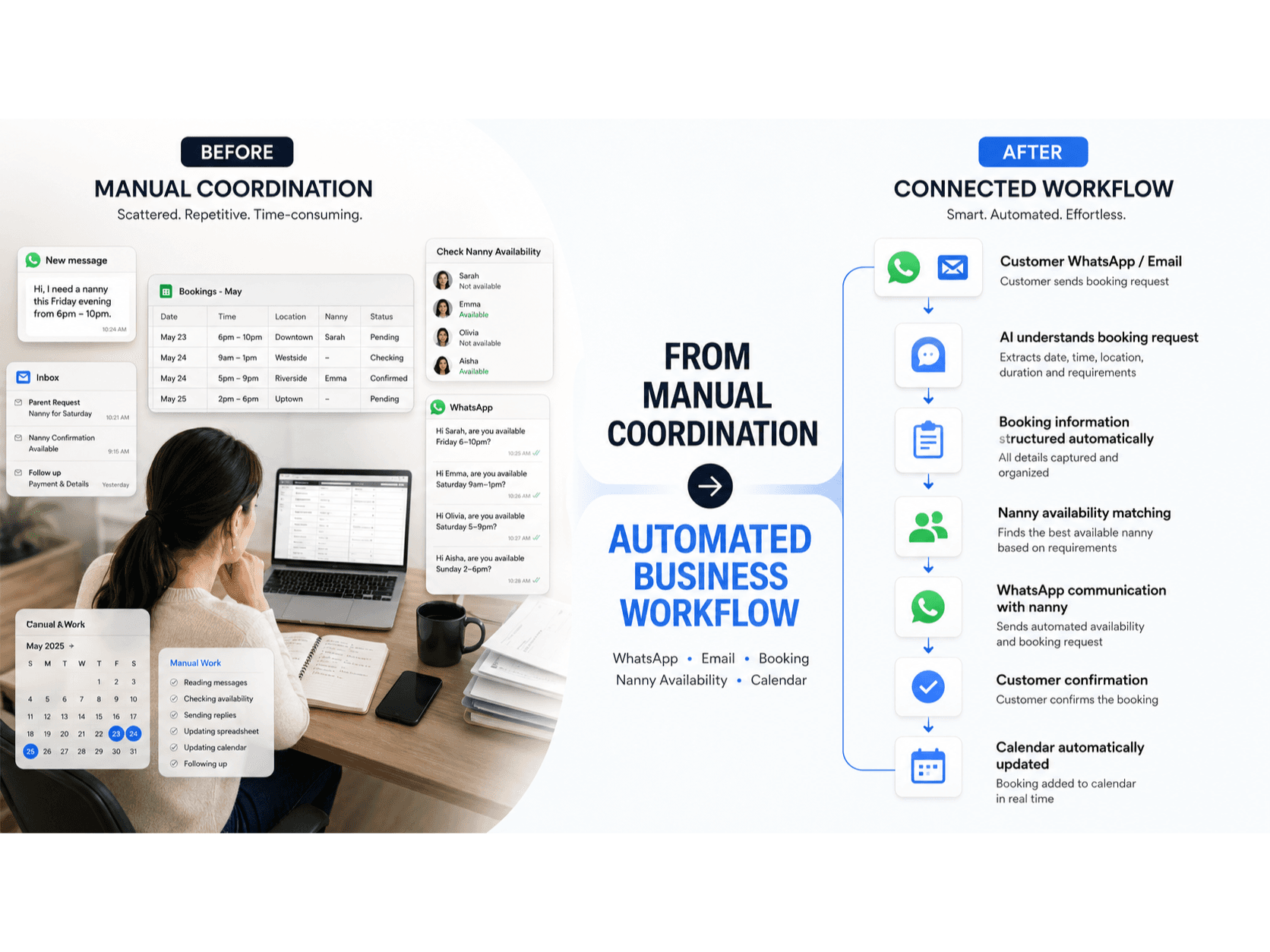
At a glance
Here's the short version. A nanny agency was running every booking by hand across WhatsApp, email, a spreadsheet and a calendar. We swapped all of that for one workflow that handles the whole thing on its own. The team got back around 10 to 12 hours a week, started replying to parents in minutes instead of the next morning, and stopped losing enquiries that used to slip away overnight.
The figures here reflect what a typical agency of this size can expect, based on industry benchmarks and how the workflow behaves in practice.
The business
It's a small agency, the kind of place where the owner still knows every nanny by name. Parents love it. The catch is that parents don't book during office hours. They message on a Friday evening asking if someone can watch two kids from six to ten, and somebody on the team has to catch that, work out the details and sort it before the family gives up and calls the next agency on their list.
How it used to work
Every booking went through the same routine. Someone read the message, figured out what the parent actually needed and wrote back for the bits that were missing, like the ages of the kids, the address, the exact hours. Then they opened the spreadsheet to see who was free, messaged a few nannies one at a time, and waited. Once a nanny said yes, they went back to the parent to confirm, added the job to the calendar and sent out a confirmation.
None of that is difficult on its own. The trouble is doing it dozens of times a week, mostly in the evenings and at weekends when everyone would rather be off the clock. It added up to something like 10 to 12 hours a week of shuffling information between apps, and the team still missed enquiries they never got to in time.
What that was actually costing
The real cost wasn't the admin. It was the bookings that never happened.
Most people book with whoever answers first. The research puts it at around 78% of customers going with the business that replies first, while the average company takes almost two days to get back to a new lead. Reply within five minutes and you're roughly 21 times more likely to win the job than if you reply half an hour later. A team doing this by hand can't hit those numbers after hours, so a fair share of evening enquiries were quietly drifting to whichever competitor happened to be quicker.
There was a smaller cost too. Retyping the same details across four tools left room for the odd double-booking, the occasional wrong time, and reminders that didn't always go out.
What we built
We replaced the manual routine with a single workflow that sits behind the channels parents already use. A parent writes in normally, something like “Hi, I need a nanny Friday from 6 to 10 PM for two children,” and the system takes it from there. It only asks for what's genuinely missing, finds a nanny who's actually free, checks with the nanny and the parent, and books it in.
How a booking runs now
What changed
Same team, same nannies, far less friction.
Why it works
It comes down to two things: speed and reach. In this line of work the fastest reply usually wins, so answering in minutes at eleven at night beats a careful reply the next day. And WhatsApp gets opened almost every time, somewhere around 95 to 98% versus about 20% for email, so the confirmations and reminders don't get ignored. Automating the dull middle bit just lets a small team behave like one that's always awake.
It handles the awkward cases too
Real bookings get messy, so the workflow expects it. If a nanny says no, it moves on to the next good match. If nobody's free, it tells the parent and offers other options instead of going silent. And when something's genuinely sensitive, or a parent clearly wants a person, it hands the whole conversation to a team member with the context already there. The automation does the repetitive part, and people handle the judgment calls.
This isn't only about nannies
We used a nanny agency because it's easy to picture, but the workflow doesn't really care what you're booking. The same setup works for appointments, home and field services, cleaning, clinics, recruiting, property management, consultations, sales enquiries, and plenty more. If your team is currently the glue holding a booking together across a few different apps, this is the thing that replaces the glue.
The point
Call it a booking bot if you want, but that sells it short. What it really shows is how we take a process a business is running by hand and turn it into something that runs itself, tying the customer conversation, your data, your staff and your calendar into one flow. If your people are still copying details between WhatsApp, email, a spreadsheet and a calendar, this is what takes that off their plate.
Laten we iets bouwen
dat de lijst haalt.
Vertel ons over uw project. We reageren binnen 24 uur met een duidelijk plan en transparante prijzen.